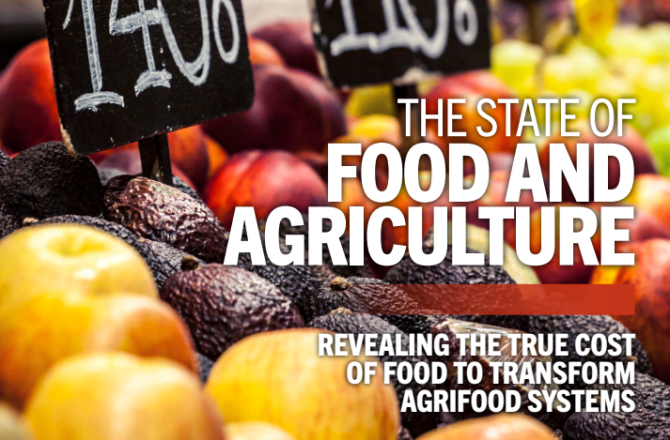
FAO – State of Food & Agriculture, 2023
Summary
The report discusses the benefits and negative impacts of agrifood systems on society.
While agrifood systems provide food and livelihoods for billions of people, their unsustainable practices contribute to climate change, resource degradation, and the lack of affordable healthy diets. The main challenge is that stakeholders lack a comprehensive understanding of how their activities affect economic, social, and environmental sustainability in their day-to-day decision-making. The State of Food and Agriculture 2023 aims to address this issue by examining the true cost of food for sustainable agrifood systems. The report introduces the concept of hidden costs and benefits in agrifood systems and proposes a true cost accounting (TCA) approach to assess them. It suggests a two-phase assessment process, starting with national-level assessments to raise awareness and then moving towards targeted evaluations to prioritize solutions. The report provides initial national-level assessments for 154 countries, revealing that global hidden costs from agrifood systems amount to at least 10 trillion 2020 PPP dollars. Low-income countries bear the highest burden of these costs relative to their national income. These estimates highlight the urgent need to consider hidden costs in decision-making for transforming agrifood systems. To implement the TCA approach, the report emphasizes the importance of research and data innovations, as well as investments in data collection and capacity building. This is particularly crucial for low- and middle-income countries, where TCA can become a valuable tool for informed decision- and policymaking in a transparent and consistent manner.
Region:
Published:
Author(s):
Language:
Geopolitical drivers:
Found an inaccuracy in the description? Let us know 🙌
Latest Viewed Reports