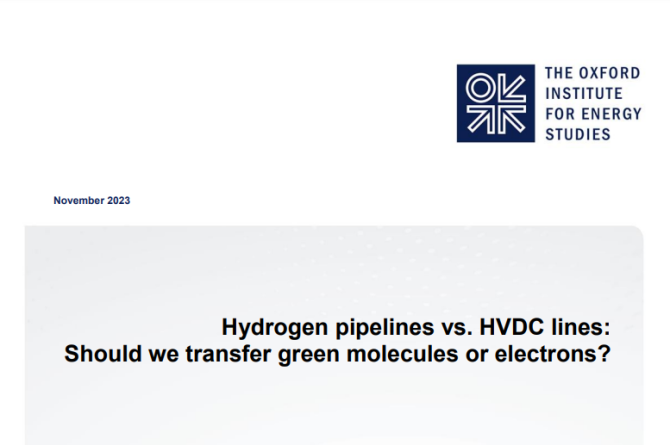
Oxford – Hydrogen pipelines vs HVDC lines
Summary
The energy sector is transitioning from traditional fossil fuels to sustainable sources in order to achieve decarbonization.
While renewable electricity is important, it has limitations such as geographical constraints and intermittency issues. This means that a mix of energy sources will be needed in the future to address these challenges. Currently, when renewable energy generation is insufficient, fossil fuels are used to supplement the power supply. Conversely, when there is surplus renewable energy, it is often wasted. To address these issues, the concept of producing carbon-neutral hydrogen through power-to-X processes has gained traction. Green hydrogen offers the potential to integrate renewable energy sources and decarbonize sectors that are difficult to electrify. However, a challenge arises in delivering green energy to where it is consumed. Transmitting electricity over long distances results in energy losses and reduced efficiency. High-voltage alternating current (HVAC) transmission systems are currently used, but they have drawbacks for transporting green energy over long distances. This is where high-voltage direct current (HVDC) transmission lines can be transformative. HVDC lines are more efficient in transmitting electricity over longer distances compared to HVAC lines, making them the preferred technology for long-distance power supply. Although the global length of HVDC lines is shorter than HVAC lines, their number is increasing, with a cumulative capacity exceeding 30 GW. This expansion is driven by the need for efficient transmission of green energy.
Region:
Published:
Author(s):
Language:
Tech drivers:
Found an inaccuracy in the description? Let us know 🙌
Latest Viewed Reports