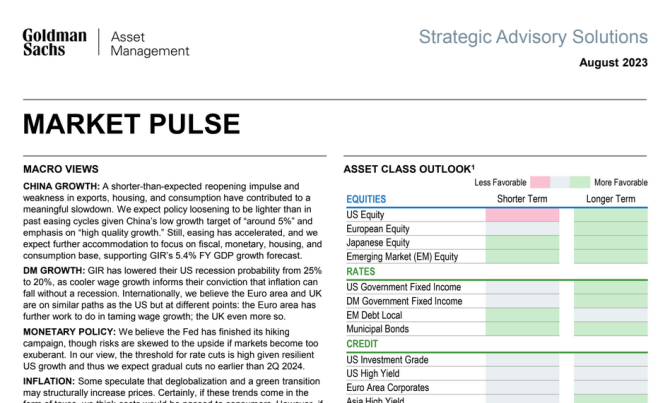
Goldman Sachs - August Market Pulse
Summary
The August Market Pulse by Goldman Sachs discusses the current state of the global economy and provides insights on various topics. In China, there has been a significant slowdown in growth due to a shorter-than-expected reopening impulse and weaknesses in exports, housing, and consumption. The government is expected to implement lighter policy loosening compared to previous easing cycles, but further accommodation is anticipated in fiscal, monetary, housing, and consumption measures to support a GDP growth forecast of 5.4%. In developed markets, the probability of a US recession has been lowered from 25% to 20%, as cooler wage growth suggests that inflation can decrease without triggering a recession. The Euro area and the UK are also on a similar path as the US, but at different stages. The Euro area needs to focus on taming wage growth, while the UK has even more work to do in this regard. Regarding monetary policy, it is believed that the Federal Reserve has completed its hiking campaign. However, the possibility of rate cuts remains if markets become too exuberant. The threshold for rate cuts is high due to the resilience of US growth, and it is expected that gradual cuts will not happen before the second quarter of 2024. Inflation is a topic of discussion, with speculation that deglobalization and a green transition could structurally increase prices. Depending on whether these trends come in the form of taxes or subsidies, the impact on consumer costs will vary. The report also highlights four themes to focus on during the earnings season in the US, including margins, financials, AI risks and opportunities, and the state of the consumer. US Treasury yields are believed to have peaked, but risks are skewed to the upside. The US dollar is expected to depreciate in the long term, but the descent may be volatile. Active management is still preferred, despite concentration limits leading to underperforming mutual fund managers in top-performing companies.
Region:
Published:
Author(s):
Language:
Geopolitical drivers:
Found an inaccuracy in the description? Let us know 🙌
Latest Viewed Reports