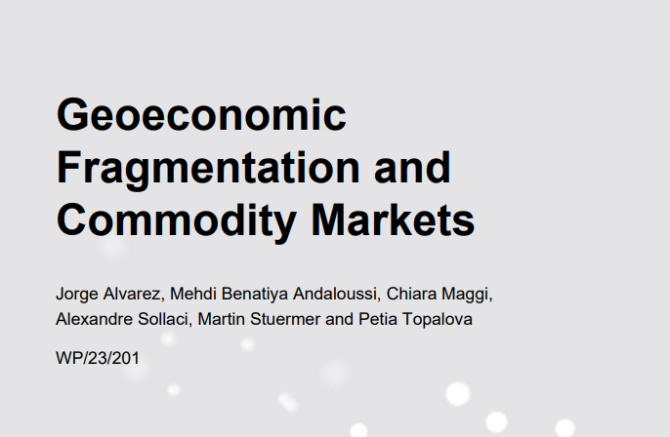
IMF – Geoeconomic Fregmentation and Commodity Markets
Summary
The introduction to the IMF paper "Geoeconomic Fragmentation and Commodity Markets" discusses the impact of geopolitical tensions on commodity markets and the potential economic consequences of further fragmentation.
The paper aims to assess the relative sensitivity of different commodity markets to fragmentation and to determine the potential economic losses associated with such fragmentation. The analysis is conducted in two steps. First, a new dataset is created, linking production and bilateral trade flows for 48 energy, mineral, and agricultural commodities. Then, a single-commodity partial equilibrium trade model is developed to examine the potential impacts of fragmentation on trade flows, prices, and production for each commodity. The paper simulates a hypothetical fragmentation scenario in which the global market for each commodity splits into two theoretical blocs. The price change in the two blocs is assessed, assuming no trade between blocs but unaffected intra-bloc trade costs. The change in commodity prices is used to measure the vulnerability of each commodity to fragmentation. The economic consequences of fragmenting individual commodity markets are also investigated by calculating the change in total economic surplus. The paper documents key features of commodity markets, such as their low demand elasticities and geographical concentration of production. It also highlights that further fragmentation could lead to wide price differentials across blocs and higher price volatility. The impact of fragmentation on economic surplus varies across commodities, with energy commodities having significant declines in economic surplus due to their wide consumption and production. However, the results of the paper have two main caveats. First, the assumption of complete commodity trade fragmentation across blocs and free trade within blocs is highly stylized, and more realistic intermediate scenarios are not considered. Second, the partial equilibrium nature of the analysis does not account for the simultaneous disruption of trade for multiple commodities.
Overall, the paper provides commodity-specific measures of relative price-sensitivity and macroeconomic fallout potential from trade fragmentation, rather than projecting impacts from complex geopolitical fragmentation scenarios.
Region:
Published:
Author(s):
Language:
Social drivers:
Geopolitical drivers:
Found an inaccuracy in the description? Let us know 🙌
Latest Viewed Reports