S&P Global – APAC Sector Roundup Q1 2024
Summary
The S&P Global APAC Sector Roundup for Q1 2024 highlights several key takeaways.
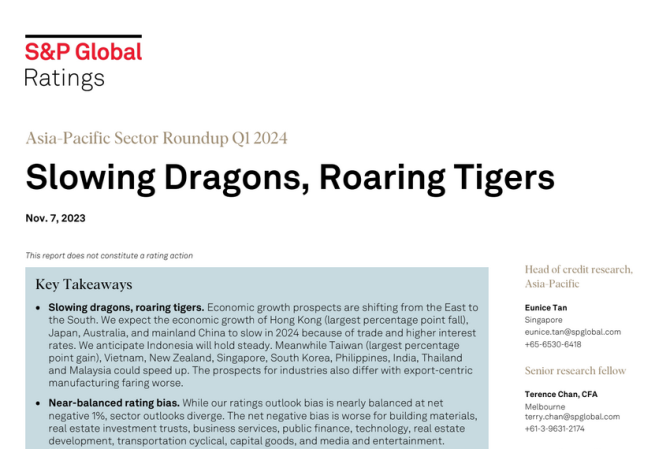
The report suggests that economic growth prospects are shifting from East Asia to South Asia, with countries like Hong Kong, Japan, Australia, and mainland China expected to experience slower growth due to trade and higher interest rates. On the other hand, countries like Taiwan, Vietnam, New Zealand, Singapore, South Korea, Philippines, India, Thailand, and Malaysia are predicted to see an acceleration in economic growth. The report also notes that the outlook for different industries varies, with export-centric manufacturing facing more challenges. The ratings outlook bias is nearly balanced, but sector outlooks diverge. Building materials, real estate investment trusts, business services, public finance, technology, real estate development, transportation cyclical, capital goods, and media and entertainment have a net negative bias. Hotels, gaming, and leisure; consumer products; auto; sovereign; transportation infrastructure; utilities; and insurance have a middling bias. Chemicals, metals and mining, telecommunications, financial institutions, oil and gas, and retail have a neutral to positive bias. The report highlights several risks to the outlook, including troubles in China's property sector, weak business and consumer confidence, high debt levels, steep interest rates, a potential global economic downturn, and borrowers' inability to pass on inflated costs to customers. Geopolitical tensions and uncertainties in Japan's monetary policy are also noted as moderate risks. The report discusses the trend of China's struggling economy and the potential shift in credit activity in the Asia-Pacific region from China to South and Southeast Asia. It also mentions the risks associated with overleveraged state-owned enterprises and government-linked companies, as well as costlier borrowing due to higher interest rates. The report notes that sticky core inflation, geopolitical tensions, and longer-term risks related to climate change and technological advancements are additional challenges for businesses in the region.
Region:
Published:
Author(s):
Language:
Geopolitical drivers:
Found an inaccuracy in the description? Let us know 🙌