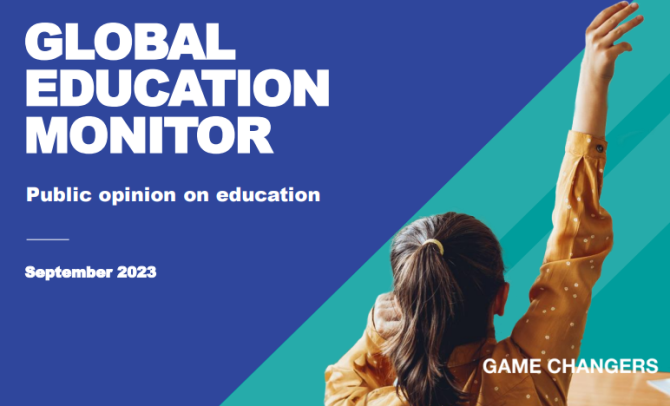
Ipsos – Global Education Monitor, 2023
Summary
The Ipsos Global Education Monitor conducted a survey across 29 countries to examine people's attitudes towards education and teaching.
The survey found that people are more likely to perceive their education systems as poor rather than good. However, opinions on the education system varied significantly between countries. Singapore and Ireland had the highest satisfaction rates, with the majority of people expressing happiness with their schools, while Hungary had the lowest satisfaction rate, with two-thirds of respondents describing their education system as poor. Key findings from the survey include: - 33% of respondents across the 29 countries rated their education system as good, while 36% considered it poor. - Parents of school-age children were generally more positive about the education system than those without children in school. - 45% of respondents would not recommend becoming a teacher, compared to 43% who would. - In most countries, having a degree was seen as very important for success in life. - Views on the impact of artificial intelligence (AI) in the classroom varied, with 35% of respondents believing it would have a positive effect, while some countries like France, the US, and Canada were more likely to think its impact would be negative. The survey also highlighted differences in attitudes among different generations. Older people were more likely to believe that the education system had worsened since they were in school, while younger generations tended to view it more positively. Additionally, older generations were more skeptical about the ability of schools to reduce social inequalities.
Overall, the survey provides insights into global perceptions of education systems, the role of teachers, and the impact of technology in the classroom.
Region:
Published:
Author(s):
Language:
Tech drivers:
Found an inaccuracy in the description? Let us know 🙌
Latest Viewed Reports