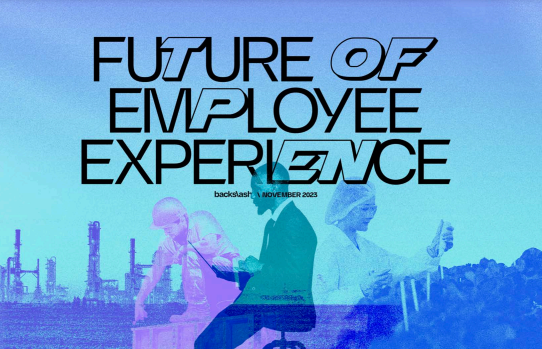
TBWA – Backslash Future of Employee Experience
Summary
The employee experience has undergone significant changes in recent years, driven by market developments, new customer demands, and shorter feedback loops.
These changes have created a need for businesses to be more responsive, putting pressure on employees to adapt and utilize new digital tools and apps. Employees are at the forefront of client interactions, working with screens and crafting effective prompts for AI helpers. In the current period of flux and transformation, employees are facing unfamiliar circumstances and need to continuously chase new skills, integrate cultural support, benefit from updated tools, advocate for workplace flexibility, and adapt to societal and environmental changes. Talent is crucial for organizations to achieve sustained growth and success. As technology competencies are rapidly learned, so are "soft" skills elevated. Empathy practices are essential for managers and employees to work together at the new tempo. Employees require elasticity and optionality as they navigate unfamiliar operating conditions and experiment with emerging technologies. Their daily tasks and outcomes are altered as new applications are adopted. To support strong individual and team performance, managers need to recognize and enhance each employee's unique value and contributions. The vision for future employee experiences includes more autonomy, flexibility, self-awareness, and empathy, supported by intuitive and personally supportive technology tools. Developing intentional communities, providing training and upskilling, and fostering resilience are necessary to meet the rising standards and expectations. Companies that co-create innovative, integrated, and inclusive employee experiences will be well-positioned for success in the future.
Region:
Published:
Author(s):
Language:
Geopolitical drivers:
Found an inaccuracy in the description? Let us know 🙌
Latest Viewed Reports