The World Bank – Food Security Update, Feb 24
Summary
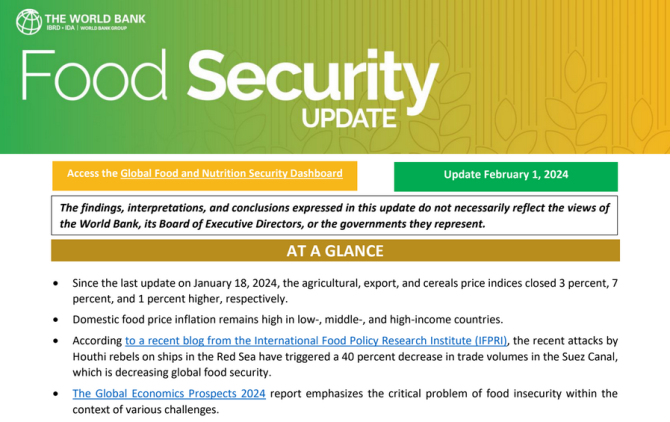
In the World Bank's Food Security Update, it is reported that since the last update in January 2024, agricultural, export, and cereals prices have seen increases of 3%, 7%, and 1% respectively.
This has resulted in high domestic food price inflation in countries of varying income levels. Furthermore, it is highlighted that recent attacks by Houthi rebels on ships in the Red Sea have caused a 40% decrease in trade volumes in the Suez Canal, leading to a decline in global food security. The Global Economics Prospects 2024 report emphasizes the significant issue of food insecurity in the face of multiple challenges. There is also a discussion of the urgent need for circular food systems to address the environmental challenges caused by the current linear "take-make-consume-dispose" model of the global food system, as outlined by the World Bank Agriculture and Food Global Practice. In terms of market outlook, the update states that agricultural commodity prices have seen increases since the previous update. Cocoa and coffee (Arabica) prices have risen by 8%, driving the increase in the export price index. Maize and wheat prices have also risen, while rice prices remain unchanged from two weeks ago. On a year-on-year basis, maize prices have decreased by 33%, wheat prices by 20%, and rice prices have increased by 32%.
Region:
Published:
Author(s):
Language:
Geopolitical drivers:
Found an inaccuracy in the description? Let us know 🙌
Latest Viewed Reports