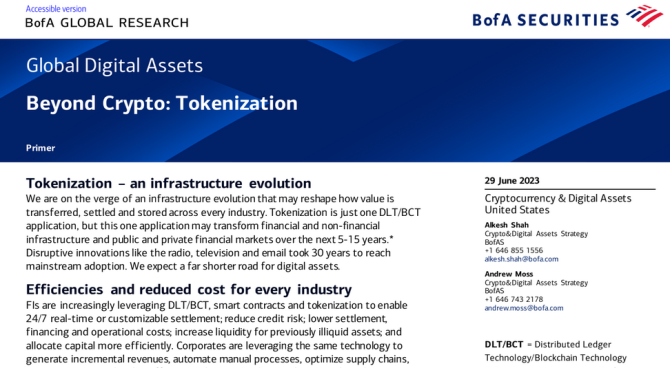
BofA - Beyond Crypto: Tokenization, June 2023
Summary
This report provides an in-depth analysis of tokenization and its potential impact on various industries. Tokenization refers to the process of creating digital programmable representations of traditional financial and non-financial assets that can be exchanged and tracked on distributed ledgers or blockchains. The report highlights that tokenization has the potential to transform financial and non-financial infrastructure, leading to efficiencies and reduced costs for every industry.
The report discusses how tokenization can benefit financial institutions and corporations by providing new opportunities for fundraising, improving liquidity, and reducing transaction costs. For example, tokenization can enable fractional ownership of assets, making it easier for investors to participate in high-value assets such as real estate or art. Tokenization can also improve liquidity by enabling assets to be traded 24/7 on a global market, reducing the need for intermediaries and increasing transparency.
However, there are also potential risks and challenges associated with tokenization, such as regulatory uncertainty, security concerns, and the need for standardization. The report suggests that regulatory clarity is needed to ensure that tokenized assets are treated in the same way as traditional assets, and that security measures are put in place to protect against fraud and hacking. The report also highlights the need for standardization to ensure that tokenized assets can be traded across different platforms and networks.
Overall, the report suggests that tokenization has the potential to revolutionize the way we think about ownership and value exchange, and could lead to significant changes in the way we do business in the future.
Region:
Published:
Author(s):
Language:
Found an inaccuracy in the description? Let us know 🙌
Latest Viewed Reports